
Photo: Eva Kolcze

Photo: Art Gallery of York University

Photo: Eva Kolcze

Photo: Art Gallery of York University
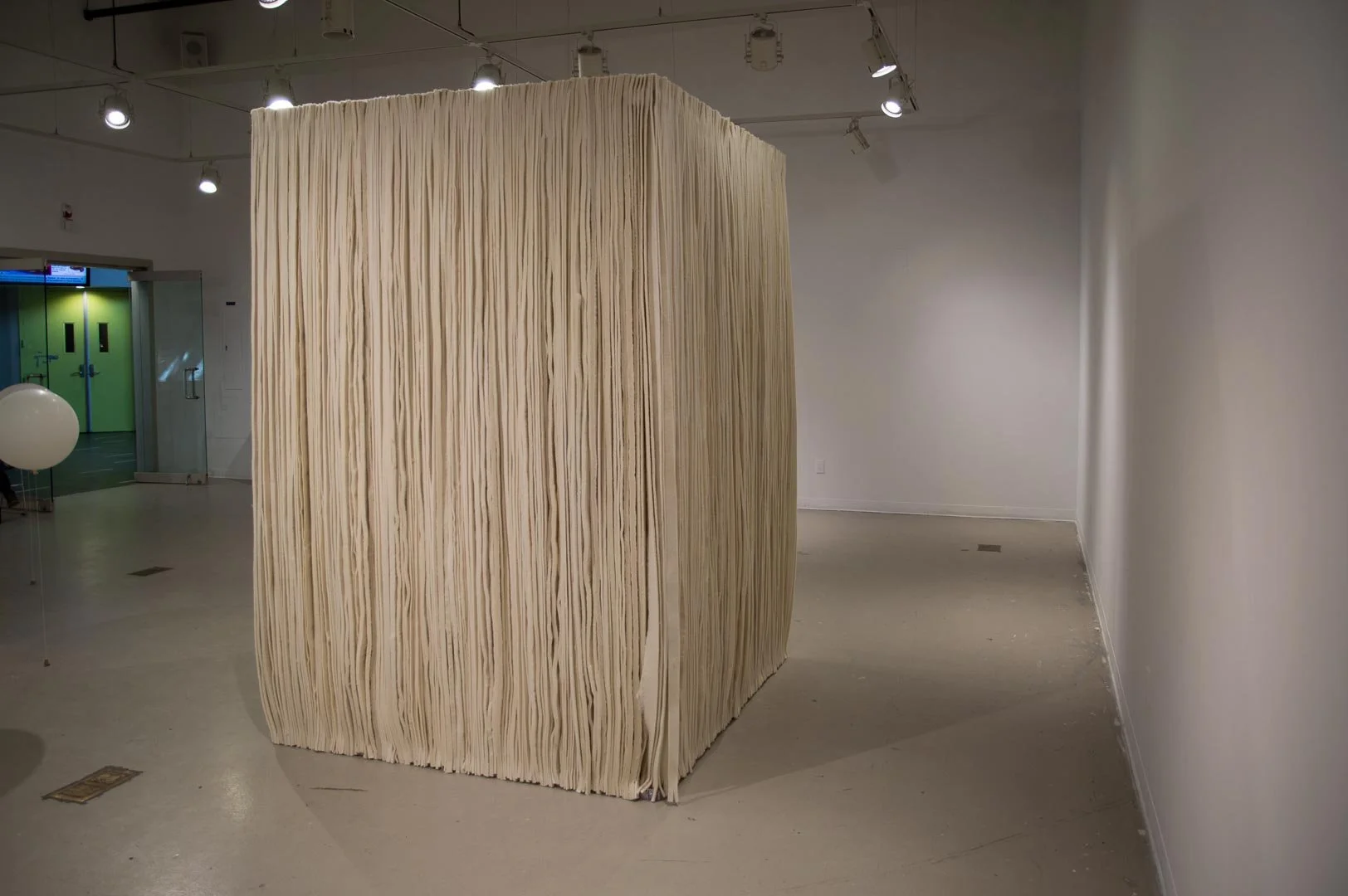
Photo: Art Gallery of York University

Photo: Art Gallery of York University

Photo: Art Gallery of York University

Photo: Art Gallery of York University

Photo: Eva Kolcze
After great pain, a formal feeling comes
Installation views of After great pain, a formal feeling comes presented by the Art Gallery of York University in partnership with York University AMPD
2016, Toronto
Curated by Megan Toye
Artists: Ellen Bleiwas, Kriss Janik, Erin Vincent
Industrial felt sourced from The Felt Store
This exhibition won a GOG Award for best First Exhibition in a Public Art Gallery
Exhibition Text (Excerpt)
After great pain, a formal feeling comes asks: how do melancholic feelings take form? Is there away to get to melancholia’s affect—the sense experience of pain, loss and grief—by attending to the material specificity of aesthetic form? And in what ways can visual forms and temporal structures act as metaphors for melancholic subjectivity?
In his 1917 text Mourning and Melancholia, Sigmund Freud distinguished between a person who is mourning and a person who is melancholic: when mourning, the individual projects the loss outward and engages in a process of working-through or healing, while the melancholic subject holds onto this loss and incorporates it into the structure of self, making the ego “poor and empty.” The works featured here by Ellen Bleiwas, Erin Vincent and Kriss Janik manifest this internalized emptiness of melancholia by incorporating a sense of loss or element of incompleteness within their formal structure, provoking engagement with what Freud termed the “particular and peculiar ache” of melancholic loss, pain and grief.
Featuring an immersive industrial felt installation by Ellen Bleiwas, mixed-media sculptures by Erin Vincent, and a sound piece by Kriss Janik, After great pain, a formal feeling comes asks how material elements can communicate affectively. That is, the works here not only rely on the materiality of their form for their composition, but they actively embrace and showcase this materiality as central to the meaning and constitution of the work. Materiality is what contains the works’ affective texture; the material is the irreducible specificity of the form, the peculiar and particular ache, of the melancholic subject.
Ellen Bleiwas’ immersive installation, entitled Passage No. 160501, is a labyrinth-like square structure with two interior enclosures. The walls are composed of industrial felt off-cuts that are compressed together vertically. Felt is sold in large rectangular sheets, and in order for the manufacturer to create this rectangular shape, they must cut off the frayed woolly edges of the felt. Bleiwas has taken these edges and has played on their duality: one side of the felt off-cut is frayed and raw, exposing the woolly materiality that makes up the felt form, while the other side is cut straight and is flat. Thus, when viewers first approach Passage No. 160501, they will see the textured edge on the outside of the structure, and, upon entering the structure, will encounter the flat and rigid edge of the cut side. This is then reversed in the second enclosure, wherein the flat edge forms the outside of the structure, while the woolly, frayed edge composes the inside.
The duality between texture and flatness creates a flow between haptic and optical visuality: the grainy wooly edge activates a sense of embodiment that “turns the eye into an organ of touch,” while the more rigid and flat cut of the edge encourages a cold and optically distant form of perception. Passage No. 160501 can thus be said to activate a perceptual antagonism, as viewers shift from a highly embodied and tactile sense experience to one that is more mechanical, rigid and controlled. The combination of a tactile and embodied experience with one that is more distant and isolating manifests, or materializes, the affect of melancholia: the grainy texture of the raw edge evokes the openness of a wound that seemingly leaks off of the form and touches the body of the viewer, while the rigid, straight cut of the inside edge condenses and represses this affective texture and the emotive content it embodies, incorporating it into the formal structure of the industrial felt itself.
In Passage No. 160501 the sense experience of loss is evoked as viewers lose the ability to see anyone or anything other than the dense weightiness of the felt that surrounds them: the passageways are narrowly constructed and purposefully restricting, providing room for only one person to move through it at a time. This sense of loss is further underscored through the muffling of sound that the density of industrial felt creates. Once viewers reach the centre of Passage No. 160501, they are thoroughly immersed within two dense walls that isolate and threaten to suffocate them. They cannot hear much from the external environment and are surrounded by the open-ended raw wounds of the wooly off-cuts.
(Full text here)